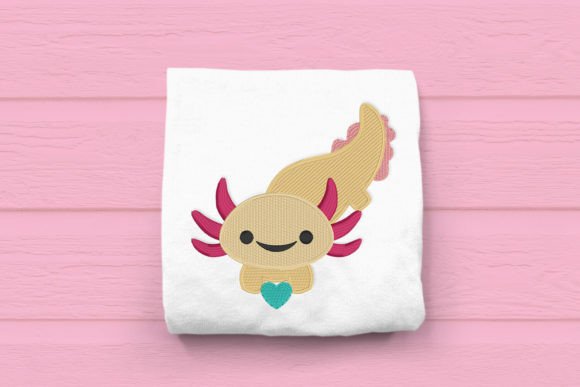
Axolotl with Heart
First Impressions: Cute, Cohesive, and Craft-Forward
As an embroidery designer who’s stitched for boutique brands from Portland to Lisbon, my first glance at Axolotl with Heart tells me this isn’t just another animal motif—it’s a mood. Soft curves, intentional negative space, and that subtle heart detail create instant warmth. The design reads as playful but not childish, whimsical but not cluttered. It lands squarely in the sweet spot small shops need: handmade charm with commercial polish. On neutral sweatshirts—think oatmeal, heather grey, or stone—it breathes quietly, letting texture and stitch quality shine. On deep navy or charcoal, the contrast lifts the axolotl like it’s floating just beneath the surface. And on pastel hoodies? It sings—especially mint, blush, or lavender—where the heart becomes a quiet focal point rather than a bold statement.
Sweatshirt Embroidery That Feels Intentional
Axolotl with Heart is built for apparel, not just digitization. The largest size uses satin stitch around the heart—a smart choice that adds dimension without overloading the fabric. Smaller sizes switch to bean stitch, which is brilliant for maintaining legibility on youth sizes or sleeve placements. That detail alone signals thoughtful design intent: this isn’t a scaled-down afterthought—it’s engineered for real-world wear. When placed on a hoodie chest (standard 3.5"–4.5" width), the proportions hold beautifully. No awkward stretching or flattening. For back designs on oversized hoodies, it scales gracefully—especially if you anchor it just below the collar seam where the curve of the garment supports the axolotl’s natural silhouette. As a sleeve accent? Ideal at 2"–2.5". The bean stitch outline keeps edges crisp even on ribbed cuffs.
What Makes This Boutique-Ready
Small shop owners know: customers don’t buy embroidery—they buy feeling. Axolotl with Heart delivers emotional resonance without sacrificing craft integrity. It feels premium because it avoids filler stitches, respects fabric drape, and honors the rhythm of hand-guided machine work. There’s no visual noise—no excessive underlay, no dense fill that fights the sweatshirt’s cozy texture. That means your finished product photographs well across lifestyle shots: draped over a café chair, layered under a denim jacket, or folded beside a ceramic mug. For Etsy sellers, that translates directly into scroll-stopping mockup previews and higher perceived value. Buyers trust handmade products that look *designed*, not assembled—and Axolotl with Heart reads as curated, not generic.
Practical Design Notes for Real Production
Let’s talk execution. Sweatshirt embroidery demands balance: enough density to hold shape, but light enough to avoid stiffness. Based on the description—satin around the heart in larger sizes, bean stitch elsewhere—I’d expect moderate stitch density. That’s ideal for midweight French terry and fleece-backed cotton blends. You’ll want a medium-weight cutaway stabilizer underneath to prevent puckering, especially around the heart’s satin area. For dark fabrics, stick with high-contrast thread colors: soft rose for the heart, charcoal grey for the body, and creamy off-white for gills and highlights. On light fabrics, go richer—burgundy heart, slate blue body, pale peach gills—to maintain depth.
Hoop placement matters here. Because the axolotl has gentle asymmetry (those frilly gills!), centering it precisely on chest placement avoids visual drift. If using on curved surfaces—like the back yoke or side seam—test hoop rotation first; the bean stitch outline adapts well, but satin areas respond best when aligned with grain direction. And yes—this design holds up through washing. Bean stitch is inherently durable, and satin stitch around a compact shape like the heart resists fraying far better than long, thin satin lines. Still, always pre-wash your blanks and recommend cold gentle cycles to customers.
Fabric Texture & Scale Sensitivity
One thing I love about Axolotl with Heart: it works *with* fabric texture, not against it. On loopback fleece, the slight loft lifts the bean stitch just enough to add tactility. On smoother cotton-poly blends, the satin heart catches light delicately. But be mindful of scale shifts. At under 2", fine details—like the subtle separation between gill filaments—may soften. That’s why the switch to bean stitch at smaller sizes is so smart: it preserves personality without demanding microscopic precision. For seasonal collections—think chunky cable-knit hoodies or brushed fleece joggers—lean into the 3.75"–4.25" range. It fills space confidently without overwhelming the garment’s inherent weight.
Brand Identity, Not Just Decoration
This isn’t just an Animals embroidery file—it’s a brand signature waiting to happen. For a boutique brand centered on wonder, biology, or gentle self-expression, Axolotl with Heart becomes instantly recognizable. Repeat buyers will spot it across your Instagram feed, your packaging stamp, even your thank-you cards. That consistency builds trust. It also opens doors: pair it with minimalist typography on tags, use it as a watermark on digital embroidery files, or animate it gently for email headers. For creative entrepreneurs selling custom apparel, it’s flexible enough to layer—think tiny axolotls along a hemline or mirrored on pocket flaps—but strong enough to stand alone as a hero design.
Final Thought: A Design That Grows With Your Shop
Axolotl with Heart is more than a machine embroidery design—it’s a strategic asset. It bridges playful and polished, handmade and scalable, nostalgic and fresh. It invites engagement (who doesn’t smile at an axolotl?), supports storytelling (resilience, regeneration, gentle strength), and elevates your small shop product from “nice” to “must-have.” Before production, confirm your embroidery file includes all sizes referenced, verify thread color recommendations match your palette, and test stitch-out on your exact fabric blend. But rest assured: this is the kind of Embroidery design that makes customers pause mid-scroll—and reach for their cart.