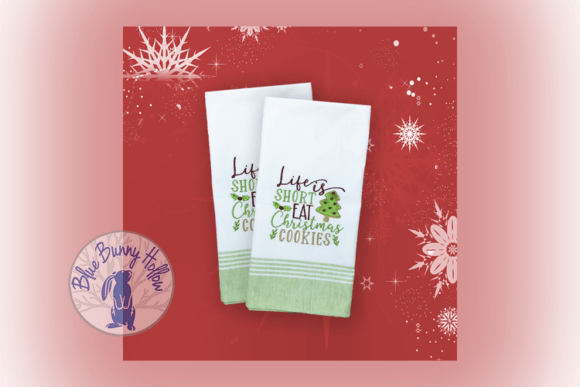
Life is Short Eat Christmas Cookies
A Seasonal Embroidery Designer’s Real-World Review
As an embroidery designer who’s curated over 20 holiday collections for small shops and Etsy sellers, I approach every new design with two questions: Will it resonate emotionally during the rush of December shopping? and Will it stitch cleanly across multiple product types without frustrating my customers—or me? That’s why Life is Short Eat Christmas Cookies stood out immediately—not just as a cheerful phrase, but as a versatile, gift-ready anchor for seasonal embroidery.
First Impression: Cozy, Playful, and Instantly Festive
The phrase lands with warmth and wit—no forced sentimentality, no overt religious or commercial clichés. It feels human: nostalgic like grandma’s cookie tin, playful like kids sneaking dough, and cozy like a kitchen filled with cinnamon and laughter. Visually, it reads as modern-cute—clean letterforms with gentle curves, likely balanced spacing, and room for subtle decorative accents (think tiny snowflakes, holly sprigs, or rolled cookies tucked between words). There’s no heavy ornamentation, so it avoids looking dated or overly busy—a major win for holiday embroidery that must age gracefully beyond December 26th.
Where It Shines: Real Holiday Product Applications
Life is Short Eat Christmas Cookies isn’t just a saying—it’s a product catalyst. On kitchen towel embroidery, it transforms a utilitarian item into a centerpiece gift. Paired with cinnamon rolls and a mason jar of sprinkles? Instant basket magic. As sweatshirt embroidery, it adds charm to family matching sets—soft fleece, relaxed fit, zero irony required. On tote bag design, it’s functional holiday cheer for cookie exchanges or market runs. And on pillow covers or aprons, it brings lighthearted personality to home decor without shouting.
It also performs beautifully in digital contexts: printable mockups pop with its contrast and rhythm, making Instagram previews scroll-stopping. For Etsy sellers, it pairs seamlessly with “personalized gift” tags—add a name or year (“2024 Cookie Crew”) and watch conversion lift. At craft fairs, it stands out among traditional motifs because it feels fresh yet familiar—inviting conversation, not just passive browsing.
Where to Proceed Thoughtfully
Even joyful designs have limits—and Life is Short Eat Christmas Cookies deserves intentional placement. Avoid cramming it into tiny hoop sizes (<5” diameter) unless the file includes a simplified version; fine lettering can blur on dense fabrics like thick terry cloth towels or textured linen. On dark fabric, test thread colors thoroughly—cream or soft gold may read better than stark white. Metallic thread? Use sparingly and only where the design allows breathing room; tight curves or overlapping letters risk skipped stitches.
Be cautious on highly stretchy garments (like ribbed knit sweatshirts) without proper cutaway stabilizer—letter distortion is the quiet enemy of holiday deadlines. And skip curved caps entirely unless you’ve confirmed the file was digitized for complex contours. Finally, if offering this as a digital embroidery file, clarify whether it’s optimized for home machines or commercial multi-heads—stitch density and underlay matter more than ever when buyers plan bulk production for holiday markets.
Why It Strengthens Your Seasonal Strategy
This design elevates giftability instantly. It’s not generic—it implies shared joy, tradition, and presence. That emotional hook builds customer trust: shoppers recognize authenticity, especially when paired with handmade quality. Visually, its rhythm and contrast support strong visual recognition across platforms—whether stitched on a pillow cover or featured in a printable promotional graphic.
For small shop products, Life is Short Eat Christmas Cookies supports brand consistency without locking you into one aesthetic. Use warm neutrals (oatmeal, sage, rust) for rustic appeal—or crisp red/cream combos for classic holiday energy. Either way, it fits your story. And during peak season, when attention spans shrink and cart abandonment climbs, its light tone reduces decision fatigue. It doesn’t ask for deep reflection—it invites a smile, then a click.
Practical Embroidery Designer Notes
- Test thread colors on both light and dark fabric swatches—especially if offering finished products in multiple bases.
- Check stitch density before scaling: high-density fills may pucker on lightweight cotton tea towels.
- Confirm hoop size compatibility across your intended products—kitchen towels often require 6x10” or larger hoops.
- Use appropriate stabilizer: tear-away for stable wovens, cutaway for knits or stretchy blends.
- Create realistic mockups showing Life is Short Eat Christmas Cookies on actual items—not just flat templates—to set accurate customer expectations.
- Review small details post-stitch: ensure commas, spacing, and any decorative elements remain legible after washing simulations.
- Plan cohesive color palettes across your holiday line—this design pairs well with muted reds, creamy whites, forest greens, and warm taupes.
- Verify commercial licensing before selling finished seasonal products—especially if bundling with other designs or using in subscription boxes.
At its core, Life is Short Eat Christmas Cookies isn’t just festive—it’s functional storytelling. It meets shoppers where they are: tired, loving, baking at midnight, wrapping gifts with one hand and holding a toddler with the other. When your embroidery file delivers that feeling—cleanly, consistently, and warmly—it doesn’t just sell a product. It becomes part of someone’s holiday memory. And that’s the kind of seasonal embroidery that earns repeat orders, heartfelt reviews, and quiet pride in your craft.